Introduction to Therapy Dogs
I wouldn’t be surprised if you see all sorts of dogs doing their parts to help out as you go out and about in your own daily routines.
Some are keeping an eye on everyone they encounter at the airport, while others focus full attention on one single person with special needs. Michigan is home to a War Dog Memorial, highlighting and honoring those that have active-served in the military. Each of these types and others come with different sorts of training, credentialing, and rules for interacting with you and me.
“Therapy dogs” are paired with named handlers, formally certified, and covered by insurance administered by one or more of the testing agencies with which they hold ongoing memberships in good standing. Tried and true affiliations include Alliance of Therapy Dogs ( “ATD”), American Kennel Club (also known as “AKC”), and Canines for Christ.
Here’s a nice description by AKC.
Therapy dogs are dogs who go with their owners to volunteer in settings such as schools, hospitals, and nursing homes.
From working with a child who is learning to read to visiting a senior in assisted living, therapy dogs and their owners work together as a team to improve the lives of other people ….
Our dog Jasper is credentialed with both my husband and me as his handlers, through Alliance of Therapy Dogs and Canines for Christ. In addition to that, I am authorized to test and sign-off on therapy dogs through AKC and Canines for Christ. My first certification as a handler was with Timber, a purebred Samoyed; my latest prior to now was Teddy, a lab-mix that was eight-years-old when we rescued him from Michigan Humane in Westland.
We’ve never had call for a claim against our insurance — so that may make me an ideal advocate for having it. The ATD website says, “Most facilities … want proof of adequate liability insurance on any teams working in their facility.” My advice to “facilities” is to be one of the “most,” without exception.
Alliance of Therapy dogs expands on this to its members this way.
ATD’s liability insurance policy covers you as a team in the case of an incident while you are volunteering. These incidents can be anything from a dog bite to someone being headbutted by your dog. Insurance also covers property damage from an incident, such as someone tripping over your dog’s leash and ruining a decoration at the facility. ATD currently has a $5,000,000 liability policy on each volunteer team.
Moving forward from legalism to leash, I’ve often wondered if “therapy dog” is the best way to understand what it means to volunteer in this way, or, from the “facility” side, to take in and make the most of such visits. I have the highest regard for professional mental health practitioners, and that’s not what we do: Not by training, interaction, nor length of time we spend in any one place.
Here are some examples of what therapy dogs can do and have done, which ATD lists under the label of bringing smiles and joy.
- Hospitals: Visits by dogs can be a welcome diversion from What if…? worries and next rounds of testing. We make time to be available for medical teams, support personnel, and loved ones in waiting rooms as well.
- Nursing Homes: Therapy dogs can serve as adjuncts to enrichment program offerings, as “the main attraction.” They are particularly effective in connecting with memory care patients, where “language” and gentle touch occur differently.
- First Responders: Dell and I have a special heart for this too often under-appreciated group and the need for gentle touchstones that most could never imagine asking to receive.
- Military Bases. While we’ll never be able to be there for the men and women who serve while they face the worst at its worst, whenever and wherever called to do so, the opportunities to make the most of here are prior to deployments and to add that much more to Welcome Home! gatherings. (See example by a blind dog for inspiration.)
- Homeless Shelters: In a place that literally comes after “no other options,” an unconditional interest of a therapy dog can feel like manna from Heaven. On top of that, a number of people will have had to give up their own pets before being allowed to enter.
- Funeral Homes: Therapy dogs can and do provide an opportunity see things from a different perspective, of course. But they can lean into these experiences of ultimate loss as well; “many funeral homes include a resident dog that obviously has an affinity toward grieving people.”
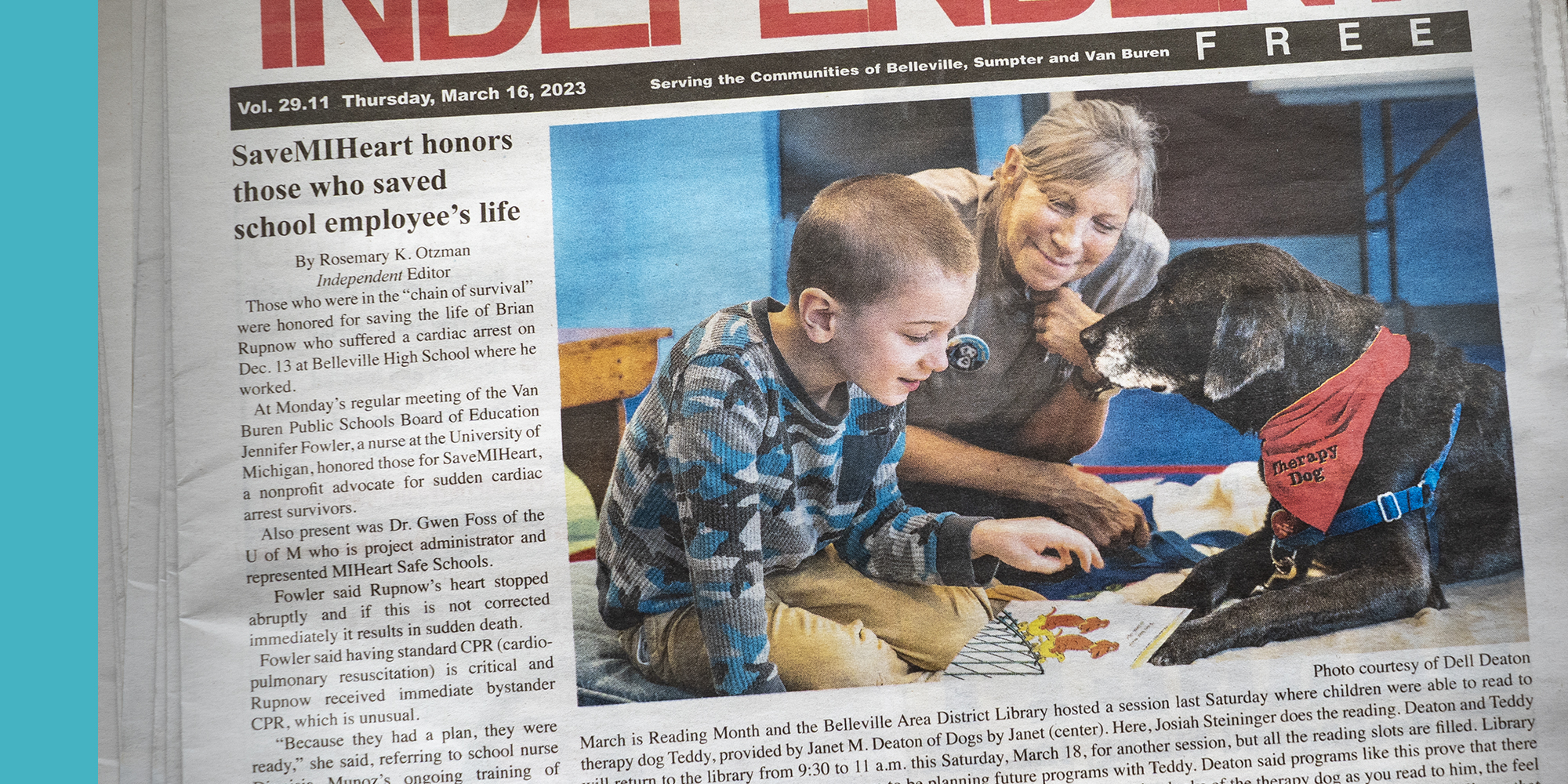
- Children: An ability to enter the world of a child without judgment is both powerful and unique. Our community outreach canine Teddy had a gift for engaging with elementary-age youth in programs, where he maintained eye contact as they read to him out loud — never “correcting” pronunciation or doing anything other than build their confidence toward becoming lifelong learners! And from there, the examples are almost endless.
If any of the above sounds even a little bit like your place in the Tri-Community, consider getting in touch with me to discussion options for finding a therapy dog fit for your needs.
— Janet Deaton